


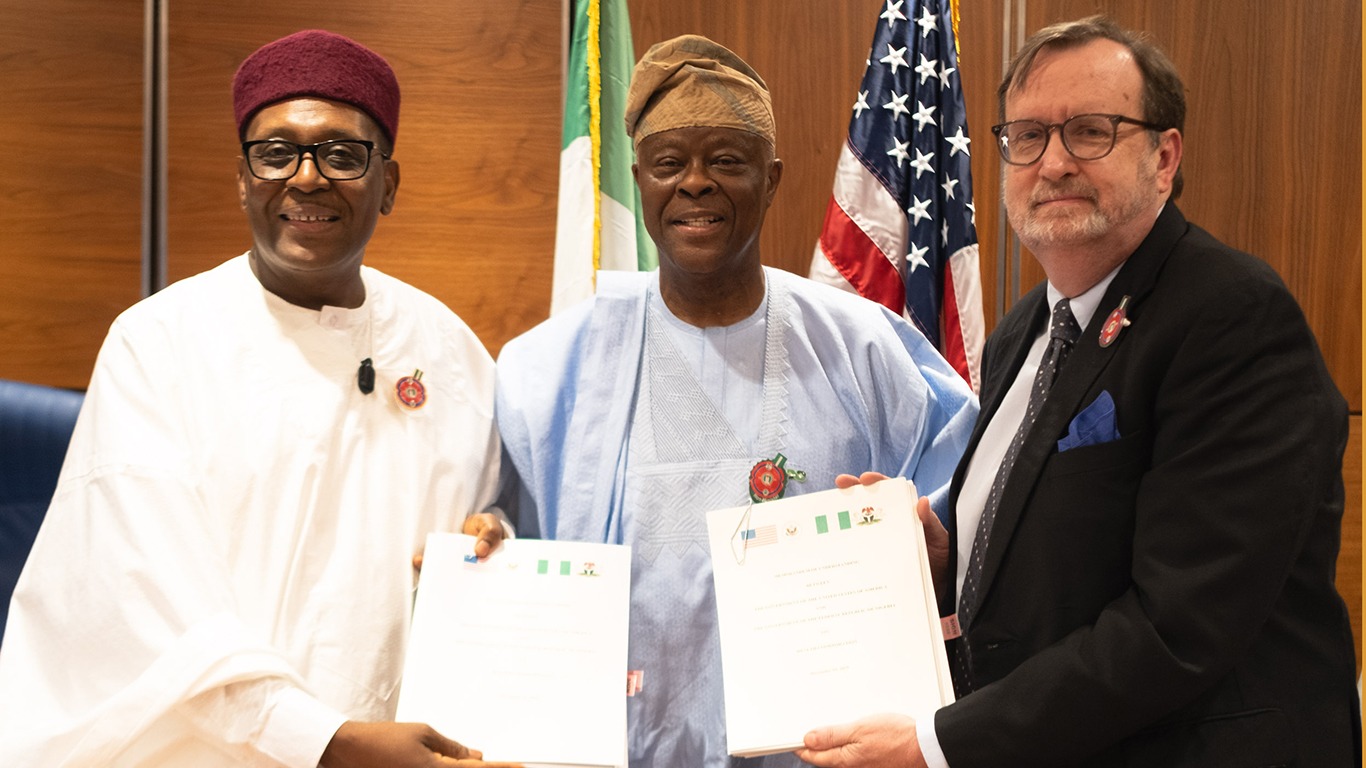
The United States and the Federal Republic of Nigeria have signed a historic five-year, $5.1 billion bilateral health cooperation Memorandum of Understanding (MOU), marking one of the most significant health partnerships between the two nations to date.
The agreement advances the America First Global Health Strategy while reinforcing Nigeria’s healthcare system, saving lives, and strengthening global and U.S. health security.
Under the MOU, the United States intends to provide $2.1 billion in health assistance, while Nigeria has committed $3.0 billion in new domestic health spending over the five-year period. This represents the largest co-investment by any country under the America First Global Health Strategy, underscoring a shared commitment to partnership, accountability, and long-term sustainability.

The agreement is structured to run through the end of the decade, embedding health investments into Nigeria’s national planning and budget frameworks.


Strengthening Health Systems and Saving Lives
The MOU is designed to strengthen Nigeria’s healthcare system by expanding access to essential services, improving disease prevention and response, and building resilient health infrastructure capable of addressing both current and emerging threats. Key focus areas include:
-
Prevention and control of infectious diseases, including HIV, tuberculosis, malaria, and polio
-
Maternal, newborn, and child health services, particularly in high-burden communities
-
Primary healthcare expansion, laboratory systems, and workforce capacity
-
Health data and surveillance systems to support evidence-based decision-making
Nigeria faces some of the world’s most pressing health challenges, including one of the highest maternal and child mortality rates globally and approximately 30% of the global malaria burden. By targeting these priority areas, the partnership aims to significantly reduce preventable deaths while improving health outcomes for millions of Nigerians.
Dedicated Support for Faith-Based Healthcare Providers
A distinctive feature of the agreement is its recognition of the critical role played by faith-based healthcare providers. The MOU includes approximately $200 million in dedicated support for more than 900 Christian faith-based healthcare facilities across Nigeria. These facilities will expand access to integrated services for HIV, TB, malaria, and maternal and child health, particularly in rural and underserved areas.

Although Christian faith-based clinics account for about 10% of healthcare providers in Nigeria, they serve more than 30% of the country’s 230 million people, often in communities with limited access to public health infrastructure. Strengthening these facilities ensures that lifesaving services reach populations that might otherwise be left behind.
A Shared Investment in Global and American Health Security
Beyond its domestic impact, the MOU reflects the strategic importance of Nigeria in global health security. By supporting disease prevention and health system resilience in Africa’s most populous country, the agreement helps reduce the risk of cross-border disease transmission and strengthens preparedness for future health emergencies.
U.S. officials have emphasized that the partnership not only protects Nigerian lives but also makes America safer, stronger, and more prosperous by addressing global health threats at their source. At the same time, Nigeria’s substantial domestic investment signals a shift toward greater self-reliance and national ownership of health outcomes.
Conclusion
The $5.1 billion U.S.–Nigeria health cooperation MOU represents a milestone in bilateral relations and global health diplomacy.
Through unprecedented co-investment, targeted support for faith-based providers, and a focus on sustainable health systems, the agreement lays a strong foundation for improved healthcare delivery, reduced mortality, and enhanced global health security. It stands as a model of partnership built on shared responsibility, mutual benefit, and a commitment to saving lives.