


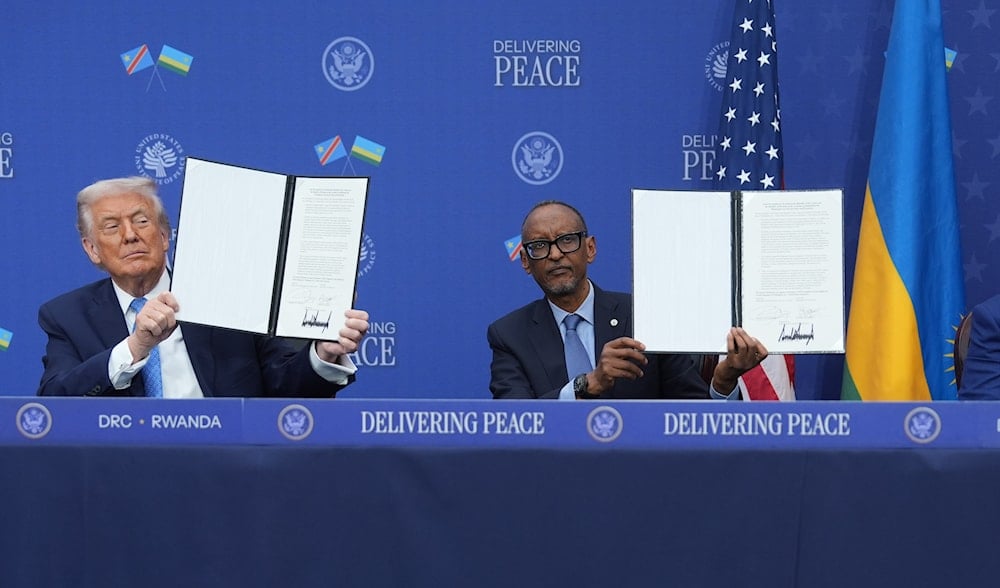
The United States and Rwanda have formalised a new five-year, $228 million health cooperation agreement aimed at strengthening Rwanda’s health system, combating infectious diseases, and advancing the America First Global Health Strategy.
The Memorandum of Understanding (MOU), was signed in Washington by Jeremy Lewin, Senior Official and Under Secretary for Foreign Assistance, Humanitarian Affairs, and Religious Freedom, and Olivier Nduhungirehe, Rwanda’s Minister of Foreign Affairs and International Cooperation.
According to the State Department, the agreement represents its second bilateral health cooperation pact and outlines a strategy intended to “save lives, strengthen Rwanda’s health system, and make America safer, stronger, and more prosperous.”
Building on Rwanda’s Progress Against HIV/AIDS
Rwanda has registered significant gains in addressing HIV/AIDS in recent years, becoming one of the few countries to achieve the global 95-95-95 targets for epidemic control. U.S. officials said the new partnership builds on this progress by shifting away from parallel NGO-run delivery systems and investing instead in Rwanda’s domestic infrastructure, workforce, and institutional capacity.


Under the arrangement, Rwanda is expected to assume full control of its HIV/AIDS response by the fourth year of the partnership, marking a transition toward greater national ownership and long-term sustainability.
U.S. and Rwandan Investment Commitments
Pending congressional approval, the United States intends to contribute up to $158 million over the next five years to support Rwanda’s fight against HIV/AIDS, malaria, and other infectious diseases, while strengthening disease surveillance and outbreak response. The Rwandan government plans to increase its domestic health spending by $70 million, gradually taking on a larger share of the financial responsibility as U.S. support winds down.
Boosting American Commercial Interests and Regional Health Security
The agreement also expands U.S. commercial engagement in Rwanda and the broader African health technology market. It builds on the State Department’s recent award to Zipline International Inc., which will help fund the production of U.S.-manufactured robotics used for delivering medical supplies.
Rwanda—an early adopter of Zipline’s drone technology—will oversee the operation and maintenance of this advanced supply chain infrastructure.
Additionally, $10 million will support Ginkgo Bioworks in scaling disease-outbreak surveillance capabilities in Rwanda, establishing a “biothreat radar” designed to detect emerging infections across the region.
Rwanda has also expressed interest in further U.S. private-sector partnerships, including next-generation HIV treatments and the application of artificial intelligence in healthcare delivery.
A Framework for Long-Term, Efficient Health Assistance
U.S. officials said the agreement reflects a shared commitment to modernising global health assistance by reducing dependency and eliminating inefficiency. The framework aims to protect public-health gains while ensuring more durable outcomes and safeguarding American taxpayer dollars.
Today’s signing underscores the strength of U.S.–Rwanda relations and a joint dedication to building a resilient, self-sustaining healthcare system capable of responding to both current and future health challenges.