


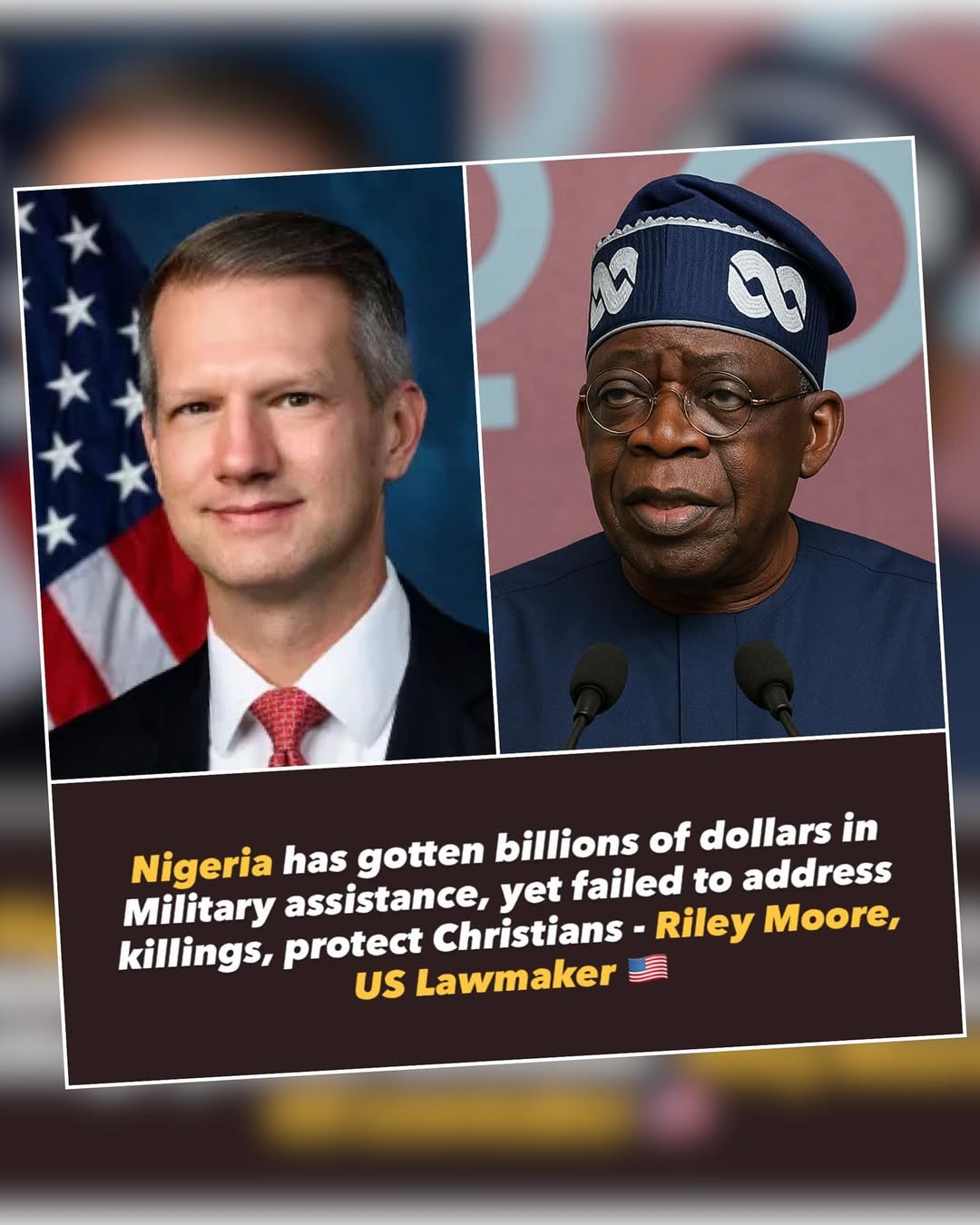
Allegations of a “Christian genocide” in Nigeria have catapulted the country into global headlines, with U.S. Congressman Riley Moore leading investigations that accuse the Nigerian government of failing to protect religious minorities. Moore’s blunt assessments place President Bola Tinubu in an unenviable position: balancing national sovereignty with mounting international pressure.
The Reality Behind the Rhetoric
President Tinubu has insisted that Nigeria guarantees religious freedom and tolerance. Riley Moore calls this a “complete falsehood,” pointing to 12 northern states enforcing Sharia law where blasphemy can carry a death penalty. In one chilling example, a Christian man currently faces execution for defending himself against a Fulani Muslim militant.
For Moore, this is proof of “serious persecution happening in Nigeria,” despite presidential assurances to the contrary.
When Politics Meets Persecution
Moore holds that President Tinubu’s predicament is not merely moral—it is intensely political. With U.S. President Donald Trump labeling Nigeria a “Country of Particular Concern” and hinting at military intervention, the stakes have never been higher. International attention, combined with domestic unrest, forces the president to act decisively—or risk irreparable damage to Nigeria’s credibility and stability.


Blasphemy Laws: Tools of Fear
Sharia penal codes in 12 states have transformed laws meant to maintain order into instruments of oppression. Churches have been destroyed, Christians imprisoned, and lives lost over charges of blasphemy or self-defense. Moore deduced that the Nigerian government’s blanket denial of persecution contrasts sharply with the stories emerging from these regions, creating a dangerous credibility gap both at home and abroad.
The Human Toll
Behind statistics and headlines are real people facing real terror. Families live in fear of attacks on their homes and farms. Communities have been displaced, lives shattered, and faith criminalized. These are not abstract numbers; they are urgent human stories demanding immediate attention.
A Leadership Test Like No Other
For President Tinubu, this is a moment of moral reckoning. Transparency, legal reform, and protection of all citizens—regardless of religion—must become the hallmark of his administration. The choice is clear: confront persecution head-on or allow the crisis to deepen, further eroding Nigeria’s national unity and international standing.
Global Eyes on Nigeria
Moore’s warnings, and the attention of the U.S. government, are more than political posturing. They are a signal that the world is watching. Nigeria can either respond with courage and integrity, or it can face escalating international condemnation, sanctions, and possibly intervention.
The Crossroads
Nigeria is at a critical juncture. President Tinubu has the chance to demonstrate leadership that transcends political calculation, which I know he has capability to demonstrate and prioritise human rights. The lives of thousands of Christians—and the nation’s credibility—hang in the balance. Inaction is not an option; the world is watching, and history will remember how he responds.
Conclusion
Congressman, Riley Moore’s accusations are more than political posturing. They reflect long-simmering grievances that many Nigerians feel deeply. For President Tinubu, the challenge is not only to defend Nigeria’s integrity but to respond — convincingly — to a moral crisis that has implications far beyond Nigeria’s borders.
If handled wisely, this moment could be a turning point: a chance for Nigeria to reaffirm its democracy, uphold the rights of all its citizens, and show the world that religious pluralism is not just enshrined on paper but lived and protected in practice.