


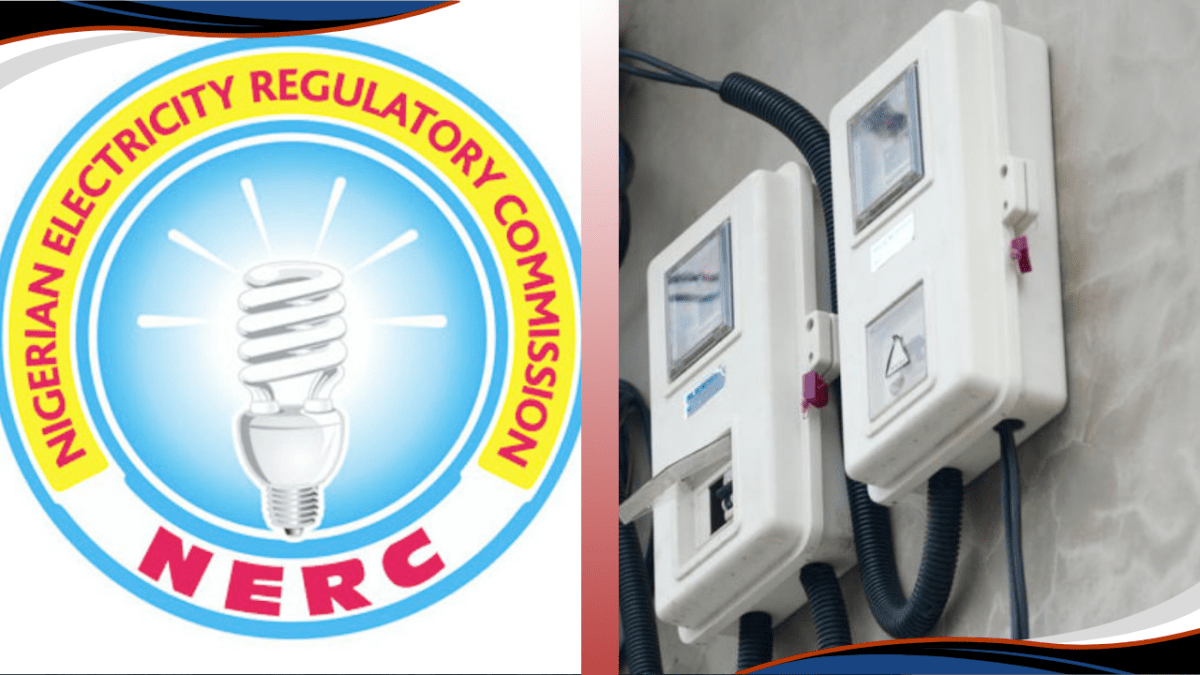
Amid widespread confusion and debate over the cost of electricity meters in Nigeria, the Nigerian Electricity Regulatory Commission (NERC), has issued a clarification: while certain meter installations are free to consumers, not all electricity meters deployed in the country are automatically free of charge.
This statement came as government agencies and power sector stakeholders sought to address misunderstandings surrounding various metering initiatives.
The clarification was made by the Chairman of NERC, Musiliu Oseni, during a radio interview with Adeola Samuel-Ilori on Fresh FM on Saturday, where he explained that while meters supplied under government-funded programmes are free at the point of installation, alternative paid options remain available for customers who are unable or unwilling to wait for the rollout.
According to Oseni, the misunderstanding arose from blanket assumptions that every meter installation must be free, following strong statements by government officials against unauthorised charges by DisCos and installers.

Government-Funded Meters Are Free
Oseni explained that meters deployed under the Distribution Sector Recovery Programme (DISREP), are fully funded by the Federal Government and must be installed at no cost to consumers.
Under the DISREP framework, the meters are financed through a World Bank-supported facility. Although electricity distribution companies will eventually repay the funding, Oseni stressed that the repayment structure does not involve collecting money from customers at the point of installation.
“The DisCos have been rolling it out. They will pay the money back, but the loan comes at a very minimal interest rate. Through the tariff, DisCos are not going to charge customers because of the meter. They are to provide it free of charge to the customers,” he added.
He further warned that no DisCo or installer is permitted to demand payment for a DISREP meter, noting that any such request is illegal.
“If you get the free meter, you are not to pay anything. No DisCo is allowed to collect money from customers because of a DISREP meter,” Oseni said.
Paid Meter Options Still Exist
Despite the free-meter rollout, the NERC chairman clarified that the Meter Asset Provider (MAP), scheme remains in operation for customers who may not be able to wait for the government-funded deployment due to timing or logistical challenges.
“There is still the Meter Asset Provider. Those residing in an area where it will take time before the free installation gets to them, and they cannot wait, can decide to pay for a Meter Asset Provider,” he said.
He cautioned customers to ensure that payments are made only to licensed companies, not individuals, to avoid fraud.
Under the MAP scheme, customers pay upfront for meters but are entitled to refunds over time through energy credits, in line with NERC regulations.
How Consumers Can Identify Free Meters
Oseni advised consumers to remain vigilant, noting that free meters can be easily identified.
“If you look at the free meters carefully, there is an inscription. After the name of the DisCo, you will see DISREP,” he explained.
This, he said, would help customers distinguish between government-funded meters and those supplied under paid arrangements.
Efforts to Close Nigeria’s Metering Gap
The NERC chairman said the commission introduced multiple initiatives after discovering that DisCos were struggling to access financing for mass metering.
He disclosed that customers who had previously paid upfront for meters under approved schemes are entitled to refunds, while those receiving free meters would recover the cost indirectly through tariff structures.
Nigeria currently has an estimated 5.9 million electricity customers without prepaid meters, a gap the Federal Government has pledged to close.
Minister’s Warning and Industry Pushback
The clarification follows a recent directive by the Minister of Power, Adebayo Adelabu, who warned that it is illegal for DisCos or installers to collect any form of payment for meters supplied under government programmes.
Speaking during an inspection of newly imported smart meters at APM Terminals in Apapa, Lagos, Adelabu said the meters—procured under DISREP—must be installed free of charge, regardless of tariff band.
“It is an offence for officials of distribution companies to request a dime before installation. Even indirect installers cannot ask consumers for a dime,” the minister said.
However, some electricity distribution companies have expressed concerns, arguing that while customers may not pay upfront, the cost of meters would still be borne by DisCos over time, raising sustainability questions.
Tariffs, Not Cash Payments
The Bureau of Public Enterprises (BPE), later weighed in, clarifying that meter costs, like other infrastructure investments, are ultimately recovered through tariffs.
The Director-General of the BPE, Ayo Gbeleyi, dismissed claims that DisCos were being unfairly burdened, noting that tariff structures already account for such investments.
“Whether it is a feeder pillar, a transformer, or a meter, we as consumers will ultimately pay for those pieces of equipment through the tariff design,” he said.
Presidential Metering Drive
Oseni also recalled that President Bola Tinubu had pledged during his campaign to close Nigeria’s metering gap, adding that DISREP is only the first phase of that promise.
He disclosed that the Presidential Metering Initiative is currently undergoing procurement under the Office of the Special Adviser to the President on Energy.
Clearing the Grey Areas
Since the Federal Government announced the free-meter initiative, many consumers have questioned why some meters still attract costs. NERC’s clarification appears to have addressed the grey areas: government-funded meters are free at installation, while paid options remain available for those who choose speed over waiting.
For consumers, the message is clear—no payment should be demanded for DISREP meters, and any such demand should be reported to regulators.
