


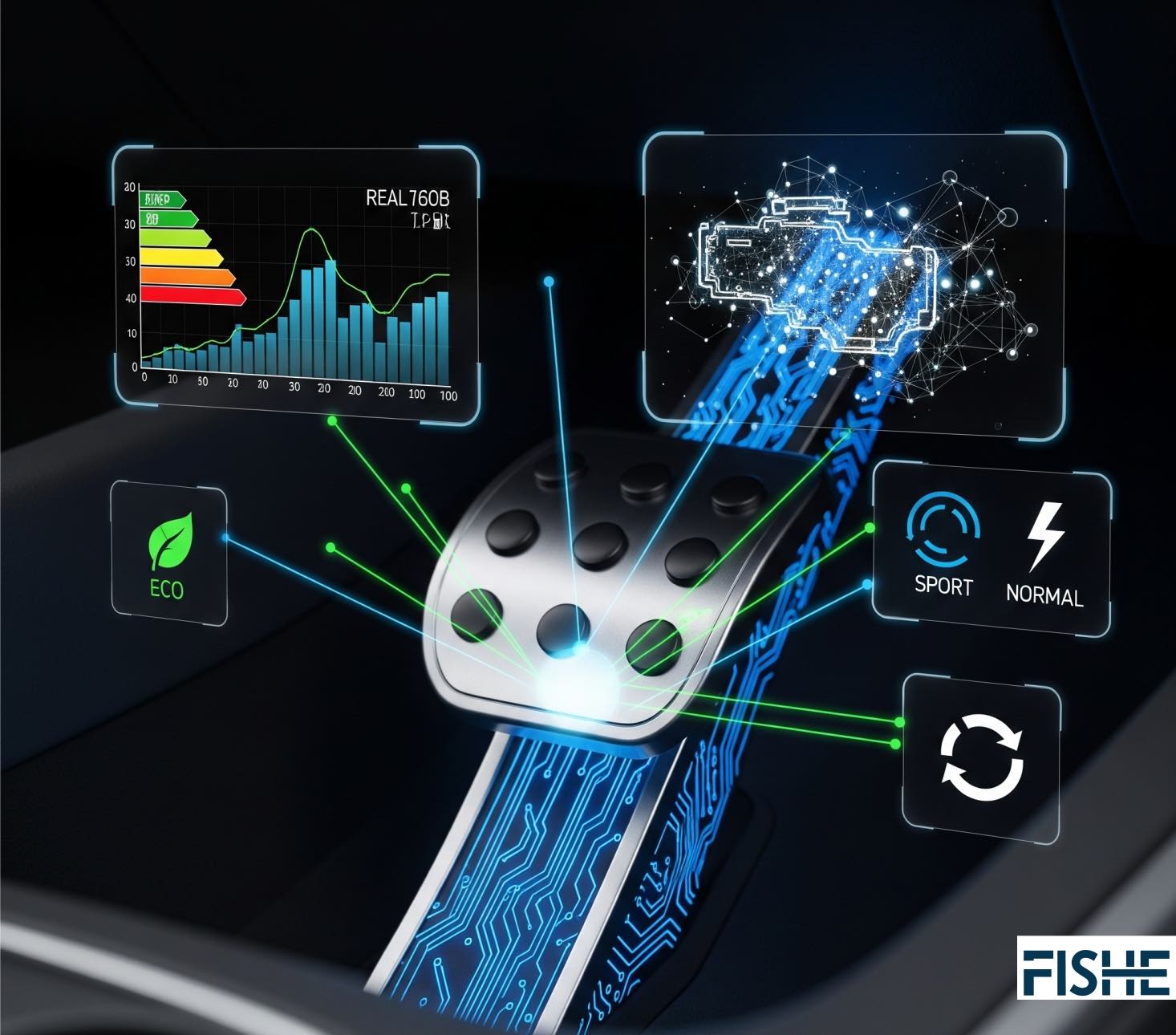
When most drivers press the accelerator pedal, they do so with a singular goal in mind: to make the car go faster. It’s a natural response that resonates with many of us that; the more you press, the faster the vehicle moves. However, what many drivers don’t realize is that the accelerator pedal serves more than just the purpose of increasing speed.
In modern vehicles, especially those built in the past two decades, boiling to electric vehicles, the accelerator has taken on an additional and often overlooked role, one that directly influences safety, fuel efficiency, and even engine management.
Let’s explore this lesser-known but critical secondary function:
1. The Accelerator as a Communication Tool with the Car’s Computer
Modern vehicles are governed by complex electronic control units (ECUs), that manage everything from fuel injection to stability control. The accelerator pedal in these cars is no longer mechanically linked to the engine via a cable. Instead, it operates as part of a “drive-by-wire” system, meaning it’s essentially an input device — like a mouse or a keyboard — telling the car’s computer how much power you’re requesting.
What many drivers don’t know is that how you press the accelerator, how quickly, how far, and how consistently gives the car’s computer cues about your driving intentions. This allows the ECU to make decisions that optimize:


-
Gear shifts in automatic transmissions
-
Turbocharger behavior in turbocharged engines
-
Fuel injection timing and air-fuel mixture
-
Throttle response in different drive modes (e.g., Eco, Sport)
So, in essence, the pedal acts as a messenger, providing critical data to the vehicle’s systems.
2. Safety Systems Rely on Accelerator Input
Another key hidden function of the accelerator pedal lies in the realm of safety overrides.
Let’s say you’re in a panic situation and mistakenly press both the accelerator and brake at the same time — something that can happen in emergencies. Most modern cars are programmed to prioritize the brake input and cut engine powerwhen this occurs. This is known as Brake-Throttle Override (BTO), a safety feature designed to prevent runaway acceleration.
Additionally, systems like Traction Control (TCS), and Electronic Stability Control (ESC), continuously monitor the accelerator input to decide when to intervene. If you floor the pedal on a slippery road, the system may reduce engine power despite your foot’s command in order to prevent a skid or spin-out.
3. Fuel Efficiency and Emissions Control
Eco-conscious drivers might be surprised to learn that their accelerator behavior can drastically influence fuel consumption and emissions, more than they might think. The car’s ECU constantly analyzes accelerator input to determine how much fuel is needed.
In fact, pressing the accelerator gently instead of flooring it can engage an “eco-map” in the engine software, which reduces fuel delivery, smooths throttle response, and delays gear shifts to keep the engine in a more efficient RPM range.
Some hybrids and plug-in hybrids even have accelerator feedback systems that gently push back on your foot if you’re driving inefficiently, a feature often referred to as “eco-coaching.” Again, this is a clear example of the accelerator doing more than just making the car go faster.
4. The Accelerator in Adaptive Systems
In cars equipped with adaptive cruise control, the accelerator works in tandem with radar and camera systems to manage speed relative to traffic. Even when you’re not pressing the pedal, the car “presses it for you” to maintain a safe following distance.
Furthermore, in vehicles with launch control (typically high-performance sports cars), the way you engage the accelerator works with other systems to coordinate the perfect start, balancing wheel spin, torque, and traction.
5. Accelerator Pedal in Regenerative Braking Systems
In electric vehicles (EVs), and hybrids, the accelerator has another remarkable secondary function: controlling regenerative braking. This is particularly evident in one-pedal driving modes. When you lift off the accelerator, the car slows down, not just due to coasting or friction brakes, but because the electric motor switches to generator mode, converting kinetic energy back into electricity.
Here, the absence of pressure on the accelerator becomes a functional input, one that slows the car and recharges the battery.
As I Down-Pen: More Than Just a Gas Pedal
While it’s commonly referred to as the “gas pedal,” today’s accelerator is far more than just a throttle control. It’s an integral part of your car’s communication network, conveying your intentions to dozens of subsystems that control performance, safety, efficiency, and comfort.
Understanding this hidden complexity can make you a more informed and smoother driver. It can also help you take better advantage of your vehicle’s technology, whether that’s improving fuel economy, enhancing safety, or just enjoying a more refined driving experience.
So the next time you press the accelerator, remember: you’re not just telling the car to go faster — you’re starting a conversation.
Hope You Know?
-
In some advanced cars, accelerator pedals are even linked to predictive systems that use GPS and terrain data to optimize engine performance based on upcoming road conditions.
-
In Formula 1, the accelerator pedal (or throttle-by-wire), is programmed to give drivers nonlinear power delivery depending on cornering dynamics and traction needs.