


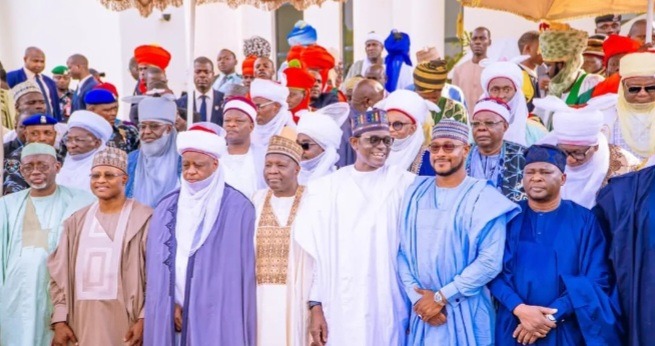
On Monday, December 1, 2025, the governors of the 19 northern states of Nigeria — together with traditional rulers — convened at the Government House in Kaduna to address the escalating insecurity that has plagued large swathes of the region.
The meeting, hosted at the Sir Kashim Ibrahim Government House and presided by the chairman of the Northern States Governors’ Forum (NSGF), Inuwa Yahaya of Gombe State, drew attendance from key governors — including Uba Sani (Kaduna), Umar Bago (Niger), Dauda Lawal (Zamfara), Mai Mala Buni (Yobe), Nasir Idris (Kebbi), Ahmadu Fintiri (Adamawa), and Abdullahi Sule (Nasarawa), among others.
From the traditional establishment, the meeting was attended by leading royal fathers, including Sa’ad Abubakar III, the Northern Traditional Rulers’ Council chair.
Why the meeting was held: dire security situation
The northern region has in recent months witnessed a worrisome surge in violent crimes: banditry, mass abductions, terrorism, and farmer–herder conflicts have all contributed to a climate of fear and instability.

Particularly alarming incidents such as the abduction of schoolchildren from institutions in Kebbi and other states, attacks on places of worship, and ambushes on security forces have prompted calls for urgent collective action.
At the meeting, northern leaders described the situation as an “existential threat” to the region — warning that without decisive and coordinated response, the future of the North could be mortgaged.
Key Resolutions and Proposals: From State Police to Security Fund
Demand for State Police Reform
A major outcome of the meeting was a renewed and unified call for the creation of a decentralized “state police” system. The leaders argued that the existing centralized policing model cannot adequately handle the size, complexity, and diverse security needs of the region — especially in rural and remote areas where many communities remain vulnerable.
They urged the national legislature to fast-track the constitutional amendments required to establish state police. The move, they believe, would decentralize security management and ensure more responsiveness at the grassroots level.
Creation of a Regional Security Trust Fund
In a significant development, the NSGF announced the establishment of a regional Security Trust Fund. Under the plan, each state and its local governments are to contribute jointly a monthly sum of ₦1 billion (deducted at source), to support enhanced security operations across the North.
The fund is intended to provide additional financing for security infrastructure, community‑based initiatives, inter‑state coordination, and rapid response — especially in areas where federal security resources are thinly stretched.
Broad Cooperation Between Political and Traditional Institutions
Recognising that security is not solely the responsibility of government, the traditional rulers pledged their support.
In remarks during the meeting, Sultan Sa’ad Abubakar III urged the governors to “listen to critics” — emphasizing that feedback from citizens and communities is vital for effective governance, trust-building, and long-term peace.
Traditional rulers volunteered to use their influence to monitor local conditions, mobilise communities, and collaborate with security agencies — especially in rural areas — to identify threats early and help prevent violent outbreaks.
Why This Matters: Stakes Are High
The North’s security crisis is not just a matter of sporadic violence — it threatens social cohesion, economic activities (especially in agriculture and rural livelihoods), education, and long‑term development. Thousands have been displaced, schools disrupted, and communities destabilized. The meeting underscores how deeply embedded and urgent the challenges are.
Moreover, the joint action — combining political authority and traditional influence — reflects a recognition that top-down white‑collar interventions alone may not suffice. Effective solutions must integrate community structures, improved policing, coordinated funding, and local ownership.
By pushing for structural reforms (state police), creating a joint security fund, and mobilizing traditional institutions, northern leaders signal a shift from reactive, state-by-state responses to a more collective, region‑wide strategy.
What to Watch Next
-
Whether the national legislature will act quickly to enable state police — and how fast relevant laws will be passed.
-
How the newly established Security Trust Fund is implemented: whether contributions start promptly, and how transparent and effective the fund is in strengthening security.
-
The role traditional rulers will play in community‑based surveillance, early warning, reconciliation, and conflict prevention.
-
Whether this coordinated approach restores public confidence, reduces abductions, banditry, and violent crimes, and improves security in remote/rural areas.
This meeting marks one of the most concerted efforts by northern political and traditional leadership to craft a unified response to the pervasive insecurity. The outcomes — if implemented — could reshape how security is managed in Northern Nigeria.
