


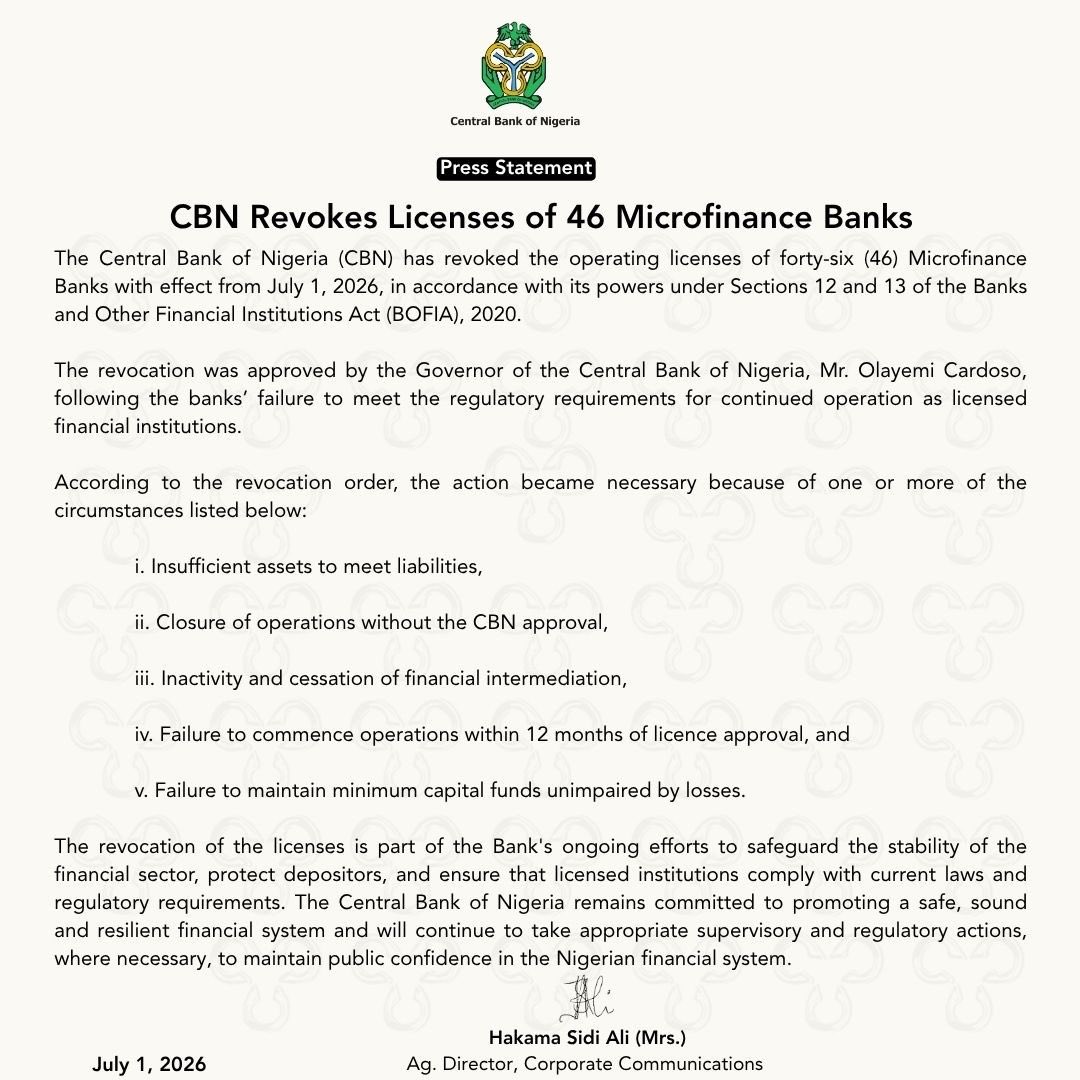
The Central Bank of Nigeria (CBN), has officially pulled the operating licenses of forty-six (46), Microfinance Banks (MFBs), starting from July 1, 2026. This action is in line with its legal authority under Sections 12 and 13 of the Banks and Other Financial Institutions Act (BOFIA), 2020.
The decision received the green light from the Governor of the Central Bank, Mr. Olayemi Cardoso, after these institutions failed to meet the necessary regulatory standards to keep their licenses as financial entities.
The revocation marks a major regulatory move in Nigeria’s microfinance banking scene in recent years, highlighting the CBN’s dedication to ensuring a stable, resilient, and well-regulated financial system.
Background
Microfinance banks are essential players in our financial landscape, offering vital services to low-income earners, small businesses, entrepreneurs, and communities that often find themselves on the outskirts of traditional banking. As licensed financial institutions, they must adhere to the prudential guidelines, capital adequacy standards, operational protocols, and corporate governance rules set forth by the Central Bank of Nigeria (CBN).

After conducting regular supervisory checks and regulatory evaluations, the CBN found that 46 licensed microfinance banks were no longer meeting the minimum criteria necessary to keep their doors open. As a result, the central bank took decisive action, exercising its authority to revoke their licenses immediately.
Reasons for the Licence Revocation
The CBN has pointed out that one or more of the following shortcomings were found in the institutions that were affected:
- There are no enough assets to cover liabilities, which points to financial insolvency.
- Operations been shut down without getting the green light from the Central Bank of Nigeria.
- There’s been a complete halt in financial activities, making these institutions practically non-operational.
- They also haven’t kicked off their operations within a year after getting the necessary regulatory approval.
- Plus, they’ve failed to keep up with the required minimum capital funds, as their capital has been weakened by ongoing losses.
These shortcomings represent violations of the regulatory requirements necessary to uphold a banking license as outlined in BOFIA 2020.
Objectives of the Regulatory Action
The CBN has announced that the purpose of revoking the license is to:
- Ensure the stability of Nigeria’s financial system.
- Protect depositors and all stakeholders involved.
- Build public trust in our licensed financial institutions and encourage adherence to banking laws and prudential regulations.
- Additionally, to boost the integrity and resilience of the microfinance banking sector.
The central bank has reiterated its dedication to implementing the necessary supervisory and enforcement measures whenever licensed institutions fall short of regulatory standards.
List of the 46 Affected Microfinance Banks
| S/N | Microfinance Bank | Category | State |
|---|---|---|---|
| 1 | Minji-Se Churchill MFB | Tier 1 | Rivers |
| 2 | Merchant MFB | Tier 2 | Abia |
| 3 | Janmaa MFB | Tier 1 | Kwara |
| 4 | Busu MFB | Tier 2 | Niger |
| 5 | Gold MFB | Tier 1 | Lagos |
| 6 | Zain MFB (formerly Dawakin Tofa MFB) | Tier 2 | Kano |
| 7 | Bompai MFB | Tier 1 | Kano |
| 8 | Ajwa MFB (formerly Gezawa MFB) | Tier 2 | Kano |
| 9 | NOW NOW Digital MFB | Tier 2 | Kano |
| 10 | Crystabel Microfinance Bank | Tier 1 | Bayelsa |
| 11 | Chanelle MFB | State | Lagos |
| 12 | Abia SME MFB | Tier 1 | Abia |
| 13 | Kamba MFB | Tier 2 | Kebbi |
| 14 | Iwade MFB | Tier 2 | Ogun |
| 15 | Winview MFB | Tier 1 | FCT, Abuja |
| 16 | Zuru MFB | Tier 2 | Kebbi |
| 17 | Minjibir MFB | Tier 1 | Kano |
| 18 | Shanono MFB | Tier 2 | Kano |
| 19 | Sumaila MFB | Tier 2 | Kano |
| 20 | Rimin Gado MFB | Tier 2 | Kano |
| 21 | Mwaghavul MFB | State | Plateau |
| 22 | Sycamore MFB | Tier 2 | Kano |
| 23 | TOFA MFB | Tier 2 | Kano |
| 24 | Safegate MFB | Tier 1 | Lagos |
| 25 | Creekline MFB | Tier 2 | Delta |
| 26 | Bestar MFB | Tier 1 | Oyo |
| 27 | Livingspring MFB | Tier 1 | Cross River |
| 28 | Apple MFB | Tier 2 | Ogun |
| 29 | Stanford MFB | State | Akwa Ibom |
| 30 | Frontline MFB | Tier 2 | Anambra |
| 31 | Zafec MFB | Tier 2 | Kaduna |
| 32 | Supreme MFB | Tier 1 | Lagos |
| 33 | Bejin-Doko MFB | Tier 2 | Niger |
| 34 | Kanopoly MFB | Tier 1 | Kano |
| 35 | Bellbank MFB (formerly Tsanyawa MFB) | Tier 2 | Kano |
| 36 | Yeneng MFB | Tier 2 | Plateau |
| 37 | Creditville MFB | Tier 1 | Lagos |
| 38 | MBAG MFB | Tier 1 | Lagos |
| 39 | Straight Sahara MFB | Tier 1 | Benue |
| 40 | OurPass MFB | Tier 2 | Ondo |
| 41 | Verdant MFB | Tier 1 | Lagos |
| 42 | Basawa MFB | Tier 2 | Kaduna |
| 43 | Casha MFB | Tier 2 | FCT, Abuja |
| 44 | Esteem MFB | Tier 2 | Kano |
| 45 | Entrepreneur MFB | Tier 1 | Lagos |
| 46 | Avantus MFB | Tier 2 | Osun |
Distribution by State
The institutions impacted are located in various states, with the largest number found in:
- Kano State – 13 banks
- Lagos State – 8 banks
- Abia State – 2 banks
- Federal Capital Territory (Abuja) – 2 banks
- Kaduna State – 2 banks
- Kebbi State – 2 banks
- Niger State – 2 banks
- Ogun State – 2 banks
- Plateau State – 2 banks
A bank in each of the following states was impacted: Akwa Ibom, Anambra, Bayelsa, Benue, Cross River, Delta, Kwara, Ondo, Osun, Oyo, and Rivers.
Distribution by Licence Category
The institutions that are impacted include:
- There are 25 Tier 2 Microfinance Banks, 18 Tier 1 Microfinance Banks, and 3 State Microfinance Banks.
This distribution shows that Tier 2 institutions made up the bulk of the revoked licenses.
Expected Implications
The revocation is likely to bring about a number of consequences:
- If you’re a customer of one of the institutions impacted, you might need to reach out to the relevant authorities, like the Nigeria Deposit Insurance Corporation (NDIC), to discuss how to recover any insured deposits that apply to you.
- This move is expected to bolster regulatory discipline in the microfinance banking sector.
- Current microfinance banks may ramp up their efforts to ensure they meet capital adequacy and operational compliance standards.
- As regulatory bodies show their dedication to upholding prudential standards, we could see a boost in public confidence in the financial sector.
Conclusion
The Central Bank of Nigeria’s decision to revoke the operating licenses of 46 microfinance banks is a major step in regulating the financial landscape. This move is all about safeguarding the health and integrity of Nigeria’s financial system. By cutting ties with institutions that haven’t met the necessary statutory and prudential standards, the CBN is working to protect depositors, encourage responsible banking, and boost confidence in the country’s financial sector.
This action sends a clear message: ongoing licensing will depend on strict adherence to regulatory requirements, financial viability, solid corporate governance, and operational integrity. As the banking environment continues to change, it’s crucial to maintain strong regulatory oversight to ensure a stable and resilient financial system that can effectively support Nigeria’s economic growth.
