
Close Menu
Fishe News
  • Home
  • Entertainment
  • National
  • International
  • Tech
  • Politics
  • Sports
  • PMNI
  • More
    • Business
    • Culture
    • Education
    • History
    • Health
  • Featured
    • Fishe Travel
    • Fishe Media
    • Fishe TV
Facebook X (Twitter) Instagram
Trending
  • The United States 175,000-Visa Revocation Question
  • U.S. Response To The 2026 Ebola Outbreak
  • Bolt Business Records Strong Growth In Nigeria Amid Rising Demand For Corporate Mobility Solutions
  • U.S. Unveils Bold New Vision For Africa’s Trade, AI, Security And Infrastructure At Landmark Addis Symposium
  • Radisson Hotel Group, Accenture Reimagine The Future Of Hotel Discovery In The Age Of AI
  • Beyond The Headlines: What Nigeria’s Recognition As An AI Leader Really Means
  • Tinubu’s Military Expansion: A Bold Blueprint For A Safer Nigeria
  • EXCLUSIVE ANALYSIS: Why Trump’s Letter To Tinubu Signals A Major Shift In US Security Policy Toward Nigeria
X (Twitter) Instagram
Fishe NewsFishe News
Subscribe
Thursday, August 13
  • Home
  • Entertainment
  • National
  • International
  • Tech
  • Politics
  • Sports
  • PMNI
  • More
    • Business
    • Culture
    • Education
    • History
    • Health
  • Featured
    • Fishe Travel
    • Fishe Media
    • Fishe TV
Fishe News
Home»Opinion

OPINION: The Rail-Energy Convergence: What Oyedele, Verheijen’s Meeting Means For Nigeria’s Infrastructure Future

A Strategic Observation by Adebayo A. Adesanya
FisheBy FisheMay 3, 2026 Opinion No Comments4 Mins Read
Share Facebook Twitter LinkedIn Email WhatsApp

A Signal In The Sequencing

Some days back, the Minister of Finance and Coordinating Minister of the Economy, Taiwo Oyedele, met with the Special Adviser to the President on Energy, Olu Verheijen. Officially, the agenda focused on coordination between fiscal policy and energy reform—expanding fiscal space for investment and rethinking Nigeria’s electricity market.

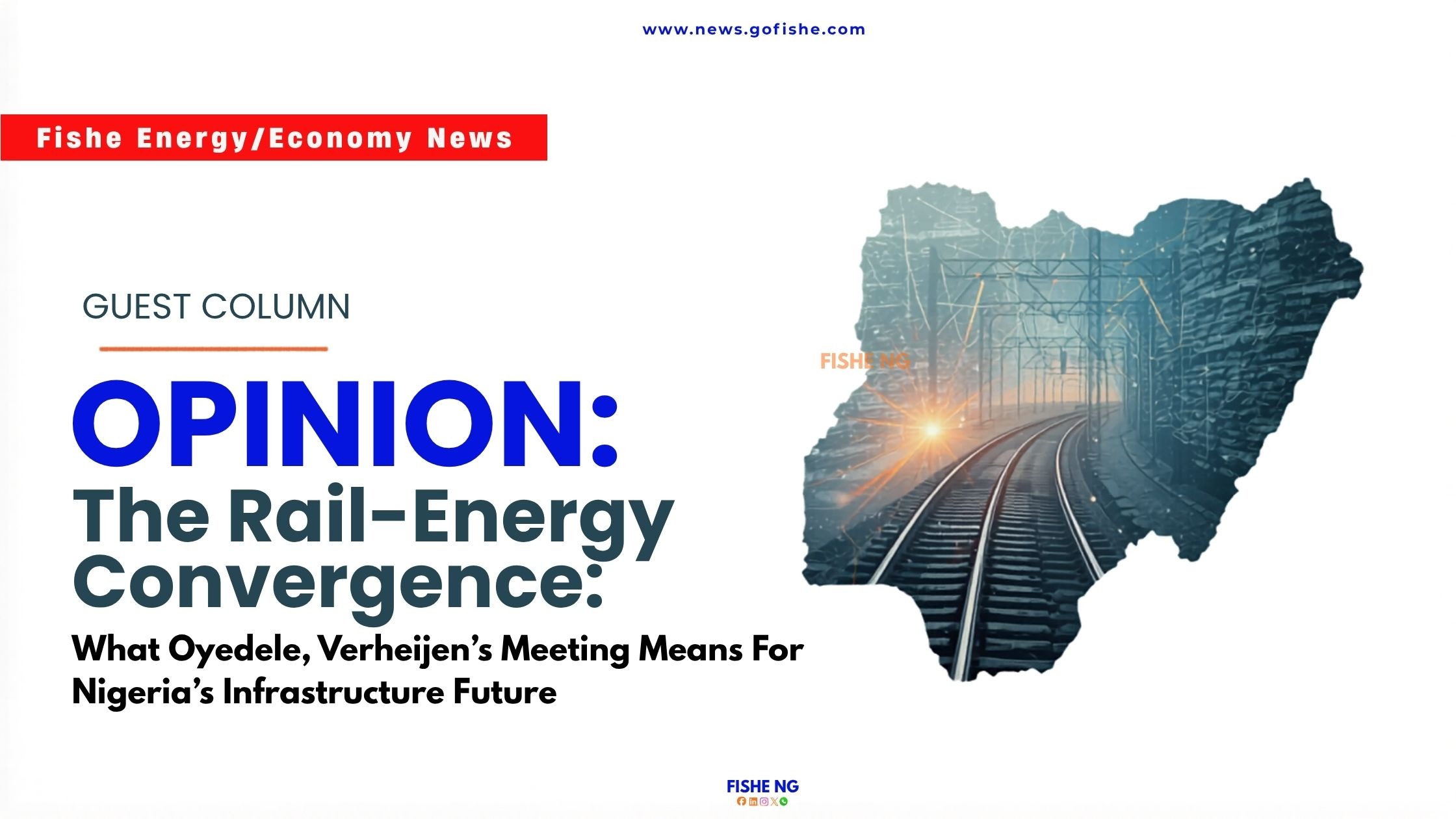
Recently, the Federal Executive Council approved three major rail projects: the Lagos Green Line (Phase 1A), the Kano Metro City Rail, and the Kaduna Light Rail. Together, they amount to roughly $2.99 billion in infrastructure spending, to be financed through the Ministry of Finance Incorporated (MOFI).

The timing is not incidental. It reflects an emerging policy logic: transport and energy can no longer be planned in isolation.

Rail Is Not Just Transport—It Is Energy Demand

Electric rail systems are among the most power-intensive public infrastructure assets a country can build. They are not passive consumers of electricity; they are anchour loads.

Nigeria already has a preview of the problem. The Lagos light rail relies heavily on captive generation because the national grid cannot guarantee the reliability it requires.



If Kano and Kaduna follow the same pattern, the country is effectively building three rail systems—and three parallel power systems to keep them running.

That is not infrastructure expansion. It is infrastructure duplication.

The Cost Of A Fragmented Grid

This duplication has real economic consequences.

When rail operators must generate their own electricity, costs rise sharply. Maintenance becomes more complex. Ticket pricing becomes politically sensitive. And the fiscal burden shifts quietly back to the state through subsidies or indirect support.

In other words, weak electricity infrastructure does not just affect households and industries—it directly undermines the viability of multi-billion-dollar transport investments.
A $2.99 billion rail programme can only deliver its full return if electricity supply is stable, predictable, and commercially reliable. Otherwise, it begins to leak value before the first train fully enters commercial service.

MOFI And The Question Of Priorities

MOFI, the government’s investment and asset management arm, sits at the centre of this financing structure. It already holds stakes in over 130 companies and is now being used to finance large-scale infrastructure directly.

This signals a deliberate shift: the state is increasingly using its balance sheet to crowd in long-term infrastructure that private capital considers too risky or too slow to mature.

That role is legitimate. But it also exposes a strategic tension.

If nearly $3 billion in financing capacity can be deployed for rail, the question becomes unavoidable: why is a comparable push not directed at electricity distribution reform—the single most important determinant of whether these same rail assets will operate efficiently?

The Real Bottleneck Is Not Capital—It Is Power

The answer is less about funding availability and more about sequencing.

The Oyedele–Verheijen engagement points to an attempt to unlock fiscal space and restructure the electricity market. And in fairness, some foundations already exist: the Electricity Act of 2023 has decentralised the sector, and Lagos has passed its own electricity law.

But the gap is no longer legal. It is operational.

Metering, billing discipline, revenue assurance, and distribution bankability remain unresolved. Without these, private and state-backed investment in electricity infrastructure will struggle to scale.

Building Two Systems Or Fixing One

At the core of the issue is a simple design choice: Nigeria is simultaneously building transport infrastructure while its energy infrastructure remains unstable.

The risk is that both systems evolve in parallel without integration—each compensating for the other’s weakness rather than reinforcing its strength.

A modern rail network cannot outperform the grid that powers it.

Either electricity is fixed first, or both are built together in lockstep. Anything else locks in inefficiency at scale.

The Test Ahead

The sequencing we have seen so far suggests awareness of this constraint. The meeting came first. The rail announcement followed.

The real test is what comes next: whether electricity reform moves from policy alignment to execution at the same pace as infrastructure rollout—or whether Nigeria continues building billion-dollar systems that must constantly work around a fragile grid.

“You cannot build a $3 billion rail network and power it with generators. You fix the grid first, or you build both in lockstep.”

#Francis #Journalism #PMNI #Rail Adebayo Adesanya Adejuyigbe Analyst Economist Energy Energy Perception Fishe NG Guest Column Infrastructure Media Agent National Image News Agency Nigeria Oyedele PR Agency Strategic Contents Verheijen
Share. Facebook Twitter LinkedIn WhatsApp
Fishe
  • Website
  • Facebook
  • X (Twitter)
  • Instagram
  • LinkedIn

We leverage creative and strategic design to amplify our clients’ products and services, capturing audience attention and transforming brand perception into real-world engagement. As a client-first B2B company, our experts are proactive, flexible, and responsive—delivering exactly what our clients need, when they need it, and before competitors do.

Keep Reading

The United States 175,000-Visa Revocation Question

U.S. Response To The 2026 Ebola Outbreak

Bolt Business Records Strong Growth In Nigeria Amid Rising Demand For Corporate Mobility Solutions

U.S. Unveils Bold New Vision For Africa’s Trade, AI, Security And Infrastructure At Landmark Addis Symposium

Radisson Hotel Group, Accenture Reimagine The Future Of Hotel Discovery In The Age Of AI

Beyond The Headlines: What Nigeria’s Recognition As An AI Leader Really Means

Add A Comment

Comments are closed.

Here is spotlighting many benefits of journeying with either Lagos State’s Blueline or Redline rails for a hassle-free day, week, month and year. Thank God for the Igbega Eko. Together we rise.
https://youtu.be/V67GV8wgyjw

Latest Posts

  • The United States 175,000-Visa Revocation Question
  • U.S. Response To The 2026 Ebola Outbreak
  • Bolt Business Records Strong Growth In Nigeria Amid Rising Demand For Corporate Mobility Solutions
  • U.S. Unveils Bold New Vision For Africa’s Trade, AI, Security And Infrastructure At Landmark Addis Symposium
  • Radisson Hotel Group, Accenture Reimagine The Future Of Hotel Discovery In The Age Of AI
Featured
About Fishe

FISHE was founded with the goal of helping clients thrive in today’s highly competitive marketing environment. While other companies rush to abandon traditional marketing in favour of digital techniques, we’ve bolstered our offline marketing capabilities while also equipping our team with seasoned professional knowledge to support our clients’ digital needs.

Through creative designs, we enhance our clients’ products and services the right way that would attract their target audience, thus, making the perception of their company a reality.

  • LTV 8, Agidingbi Road, Alausa, Ikeja, Lagos.
  • +234 806 003 7277
  • info@gofishe.com
FISHE, Your Best Plug For Bus Stop Shelter Ad

LATEST POSTS

The United States 175,000-Visa Revocation Question

August 12, 2026

U.S. Response To The 2026 Ebola Outbreak

August 11, 2026

Bolt Business Records Strong Growth In Nigeria Amid Rising Demand For Corporate Mobility Solutions

August 4, 2026

U.S. Unveils Bold New Vision For Africa’s Trade, AI, Security And Infrastructure At Landmark Addis Symposium

July 31, 2026

Radisson Hotel Group, Accenture Reimagine The Future Of Hotel Discovery In The Age Of AI

July 29, 2026
Featured

Subscribe to Updates

Get the latest news from FISHE about politics, economy, health and business, etc

Facebook X (Twitter) Instagram Pinterest
© 2026

Type above and press Enter to search. Press Esc to cancel.