


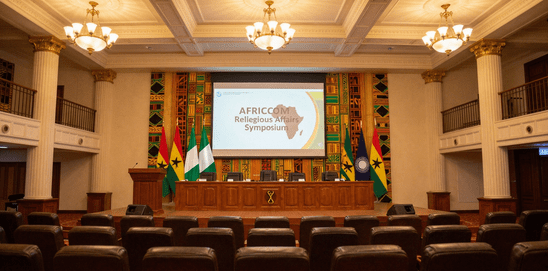
At a significant symposium in Ghana, military and religious leaders came together to advocate for ethical leadership, bolster troop resilience, and promote regional cooperation. Meanwhile, Nigeria’s Fishe Media has sparked a conversation about the need for improved operational readiness.
By Adegoke Francis
ACCRA, Ghana — Military chaplains from ten West African nations have come together to enhance their collaboration in fostering peace, ethical leadership, and operational readiness. This commitment was made during the inaugural West Africa Religious Affairs Symposium (WARAS), hosted by the United States Africa Command (AFRICOM), and the Ghana Armed Forces in Accra.
The announcement was made during an international digital press briefing organised by the U.S. Department of State’s Africa Regional Media Hub. Senior leaders from AFRICOM’s religious affairs team highlighted the growing significance of faith-based partnerships in the region’s security framework.

In a conversation with journalists from across the continent, Chaplain Colonel Kevin Forrester, the Command Chaplain of U.S. Africa Command, characterised the symposium as a strategic effort aimed at bolstering institutional partnerships among military chaplaincies in one of the most religiously diverse areas of the world.
Religion Is Africa’s Strategic Centre of Gravity
Forrester emphasized that religion plays a crucial role in African societies and should be seen as an essential element of military resilience and national stability.
“Throughout Africa, there isn’t a single country where religion doesn’t significantly shape the people and their culture,” he pointed out.
He clarified that the symposium isn’t about pushing an American model of military chaplaincy; rather, it’s about encouraging mutual learning among partner nations while honouring their unique religious traditions.
“We’re creating connections where others struggle,” he remarked. “When Muslim chaplains, Catholic priests, and Protestant ministers collaborate, it goes beyond mere religious tolerance—it becomes a source of operational strength.”
Beyond Prayers: Chaplains as Force Multipliers
Sergeant Major Herinah Asaah, who serves as AFRICOM’s Religious Affairs Senior Enlisted Leader, shared some valuable insights about the evolving role of military chaplaincy. She pointed out that it now goes far beyond just leading worship services.
According to her, religious affairs specialists have become essential frontline caregivers. They keep a close eye on troop welfare, spot early signs of stress, and assist commanders in tackling emotional, psychological, and spiritual challenges before they impact operational effectiveness.

“The best ministry happens when you show up,” Asaah emphasized, highlighting how chaplaincies are transforming from traditional office roles into dynamic, mobile, and digitally connected support systems that can reach deployed personnel no matter where they are stationed.
Having been born in Cameroon, Asaah noted that her grasp of West Africa’s religious landscape underscores the importance of providing culturally sensitive support in multinational operations.
“In this region, religion is intricately woven into daily life, identity, and culture. To build resilient military forces, we must recognise and understand that reality.”
Technology Changing Military Spiritual Care
One of the key topics that kept coming up at the symposium was the way technology is transforming how religious support is provided to armed forces.
Officials from AFRICOM shared that many of the countries involved are rolling out secure digital platforms and mobile apps, enabling troops stationed in remote areas to confidentially connect with military chaplains.
Forrester pointed out that African military chaplaincies are stepping up as innovators in this space.
“Our partners in Africa are imparting invaluable lessons on how to maintain meaningful connections with soldiers, even when geographical challenges and limited infrastructure make it tough to meet in person.”
Nigeria’s Fishe Media Raises Operational Readiness Question
One of the standout moments during the briefing was when Adegoke Francis, the Publisher of Fishe Media in Nigeria, raised an important question about how military institutions can truly assess whether religious support enhances operational readiness.

In response, Forrester pointed out that the key lies in the ability of military chaplaincies to cater to personnel from various faith backgrounds, all while fostering trust, morale, and unity among the troops.
He shared instances of Catholic priests stepping in to support Muslim soldiers until an Imam is available, as well as Protestant chaplains looking after service members who belong to different denominations.
“When every service member feels that their beliefs are honoured, they tend to perform with more confidence and dedication,” he noted.
Asaah chimed in, highlighting that Ghana’s military showcases a clear example of interfaith collaboration with a military complex where churches, chapels, and mosques coexist, symbolising harmony amid religious diversity.
Participants at WARAS are set to wrap up the symposium with an interfaith peace walk and prayers at the various places of worship.
Building Networks Against Extremism
Beyond just talking about pastoral care, officials mentioned that the symposium is playing a crucial role in helping emerging military chaplaincies build professional relationships that will continue to thrive long after the event wraps up.
Asaah pointed out that countries involved are already sharing insights on tackling violent extremism, enhancing ethical leadership, and bolstering support systems for service members and their families.
“This isn’t about one nation instructing another,” she emphasized. “Each country brings its own valuable experiences to the table, and we’re all learning from one another.”
Forrester echoed her thoughts, highlighting that some of the chaplaincies taking part are still relatively young, having been established less than twenty years ago, and they gain a lot from connecting with their more seasoned counterparts.

“The importance of having a trusted colleague in another country who truly understands your challenges is something that can’t be emphasized enough.”
Faith Partnerships as Security Investments
When discussing U.S. interests in military religious partnerships, Forrester emphasized that investing in chaplaincies plays a crucial role in enhancing peace, professionalism, and public trust in the armed forces.
He pointed out that while tactical training is important, it’s not enough to maintain strong military institutions without a solid ethical framework and moral leadership.
“Service members who feel valued and supported are much more equipped to take on the extraordinary responsibilities that come with serving their countries.”
Looking Beyond Ghana
Officials have characterised the gathering in Accra as just the starting point for a larger continental initiative.
After a similar event in Southern Africa last year, AFRICOM is gearing up to host a comparable symposium for East African military chaplaincies next year, aiming to broaden collaboration opportunities across the continent.
As the first West Africa Religious Affairs Symposium wraps up, participants believe its most significant achievement might not just be the introduction of new policies or programs, but rather the lasting relationships formed among military religious leaders dedicated to fostering peace, upholding professional ethics, and ensuring regional stability.
For countries facing challenges like terrorism, violent extremism, and increasingly intricate security threats, the organisers feel that these partnerships could be just as crucial as any traditional military strength.
