


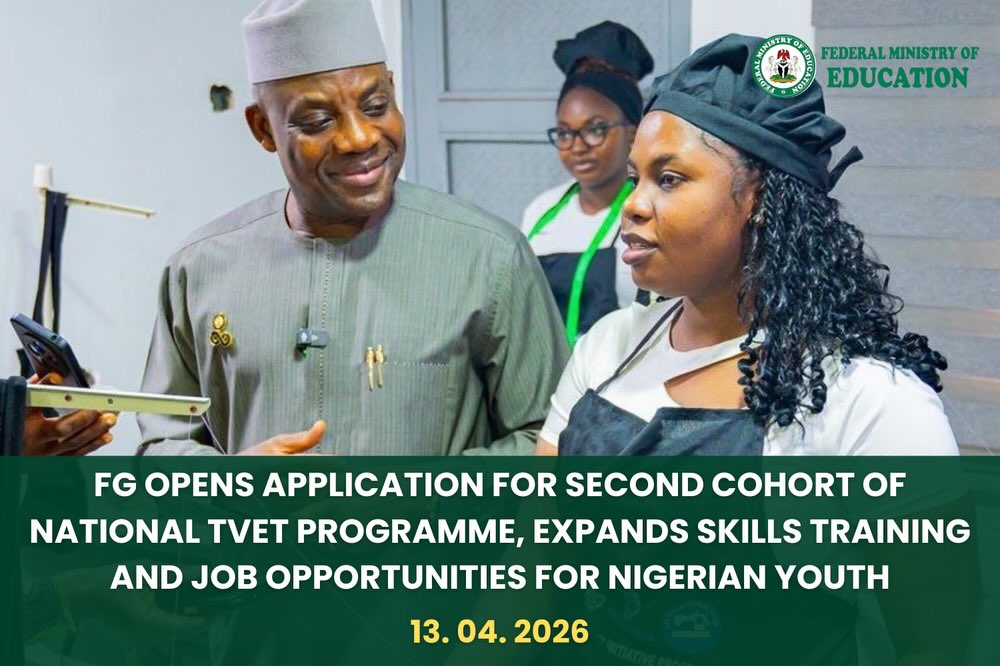
On 13 April 2026, the Federal Ministry of Education announced the opening of applications for the second cohort of the National Technical and Vocational Education and Training (TVET), Programme. This initiative is part of the Federal Government’s broader strategy to empower Nigerian youth with practical, market-relevant skills that support employment, entrepreneurship, and national development.
Policy Context and Government Commitment
The Honourable Minister of Education, Maruf Tunji Alausa, reaffirmed the government’s commitment to human capital development. He emphasized that the TVET Programme is a strategic intervention aligned with the Renewed Hope Agenda of President Bola Ahmed Tinubu.
The programme reflects the administration’s focus on reducing unemployment, enhancing productivity, and fostering inclusive economic growth.
Programme Structure and Duration
The TVET Programme is designed to provide flexible training options to accommodate different categories of participants.

It offers:
- A 6-month training programme for foundational skill acquisition
- A 1-year training programme for more advanced and specialised skills development
Training will be conducted in accredited centres located across all states of the federation and the Federal Capital Territory (FCT), ensuring nationwide accessibility.

Areas of Training
Participants will receive hands-on training in various high-demand sectors critical to Nigeria’s economic growth.
These include:
- Information and Communication Technology (ICT)
- Construction
- Agriculture
- Automotive Technology
- Creative Media
- Fashion and Garment Production
- Cosmetology
- Tourism and Hospitality
- Catering and Food Services
- Leather Works
These sectors were selected based on their potential for job creation, entrepreneurship, and relevance in both local and global markets.
Incentives and Certification
To support participants throughout the programme, the Federal Government will provide:
- A monthly stipend of ₦22,500 to assist with basic expenses
- Nationally recognised certification upon successful completion
These incentives are designed to encourage participation and ensure that trainees are adequately supported while acquiring skills.
Inter-Ministerial Collaboration
The Ministry of Education is collaborating with the Federal Ministry of Arts, Culture and Tourism to expand training opportunities, particularly in the creative and cultural industries. This partnership aims to harness Nigeria’s rich cultural assets and create additional pathways for youth employment and enterprise development.
Accountability and Monitoring Mechanisms
To ensure transparency and accountability in programme implementation:
- Attendance will be tracked using biometric systems
- Payment of stipends will be conditional on compliance with attendance requirements
Additionally, applicants are required to provide their:
- National Identification Number (NIN)
- Bank Verification Number (BVN)
These measures are intended to enhance data integrity, prevent fraud, and ensure that only eligible participants benefit from the programme.
Expected Impact
The TVET Programme is expected to:
- Reduce youth unemployment and underemployment
- Promote self-reliance through entrepreneurship
- Strengthen Nigeria’s skilled workforce
- Support economic diversification and productivity
By focusing on practical skills, the programme bridges the gap between education and industry needs.
To register and participate in the TVET Cohort 2 Programme, please click the link below and follow the instructions:
https://www.tvet.education.gov.ng/signup
Conclusion
The launch of the second cohort of the National TVET Programme represents a significant step in the Federal Government’s efforts to empower Nigerian youth and drive sustainable development. Eligible Nigerians are encouraged to apply and take advantage of this opportunity to acquire valuable skills that can improve their livelihoods and contribute to national growth.
