


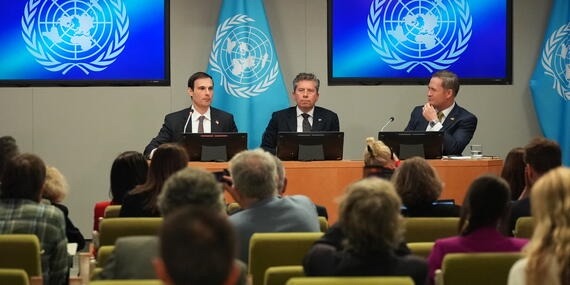
On May 14, 2026, Mike Waltz, who was then the United States Representative to the United Nations, made a significant press statement that highlighted the U.S.‘s changing approach to humanitarian funding and reform within the UN system. His speech focused on key themes like accountability, efficiency, transparency, and the need for institutional reform, all while reaffirming the U.S.’s position as the top humanitarian donor in the world.
The announcement took place in New York, where Waltz was joined by senior UN officials, including Undersecretaries Jeremy Lewin and Tom Fletcher. He revealed an additional $1.8 billion in humanitarian funding, framing this decision as part of a larger strategy dubbed the “Humanitarian Reset.” The remarks echoed the foreign policy priorities of President Donald Trump’s administration, particularly its focus on efficiency within institutions, fiscal responsibility, shared responsibilities, and achieving measurable results in international organisations.
This report delves into the key themes, policy implications, political messaging, and international importance of the statement.
Background Context
U.S. and the United Nations
The United States has long been the biggest financial backer of the United Nations and its humanitarian efforts.

American funding plays a crucial role in supporting:
– Emergency food assistance
– Refugee relief
– Disaster response
– Peacekeeping missions
– Health and development programs
Even with this prominent role, various U.S. administrations have often voiced concerns about the UN, pointing out issues like:
– Bureaucratic inefficiency
– High administrative costs
– A lack of accountability
– Prolonged peacekeeping missions that haven’t seen much success
– Overlapping programs
The Trump administration, in particular, has pushed for a more reform-focused approach to working with multilateral organisations instead of just providing financial support without conditions.
Main Themes of the Press Statement
1. Humanitarian Aid with Accountability
One of the key points in Ambassador Waltz’s statement was the belief that humanitarian funding needs to be linked to clear accountability and oversight.
He made it clear that U.S. taxpayer dollars should be used to directly support:
– Victims of natural disasters
– People affected by famine
– Survivors of earthquakes
– Those impacted by tsunamis
– Vulnerable civilians caught in crisis situations
Throughout his speech, he kept stressing the importance of efficiency in delivering aid. According to Waltz, the proposed reforms aim to make sure that “more cents on every dollar” actually reach those who need help, instead of getting lost in administrative costs.
Key Objectives Mentioned:
– Transparency in spending
– Reduced duplication
– Lower operational inefficiencies
– Faster aid delivery
– Better monitoring systems
This approach reflects a broader philosophy of governance that prioritizes results-based management and fiscal responsibility.
2. The “Humanitarian Reset”
A key part of the speech was the mention of the “Humanitarian Reset,” a reform initiative spearheaded by Undersecretary Tom Fletcher.
Purpose of the Reset
This initiative seems aimed at:
– Modernising UN humanitarian operations
– Streamlining funding structures
– Enhancing coordination among agencies
– Cutting down on waste
– Boosting operational efficiency
The statement also referred to a previously signed memorandum of understanding that included:
– $2 billion in pooled funds
– Commitments to reform
– Shared burden-sharing arrangements
The newly announced $1.8 billion adds to this framework.
Significance
The Humanitarian Reset marks a shift from unconditional multilateral funding towards:
– Performance-linked assistance
– Institutional restructuring
– Financial conditionality
– Strategic oversight
This model is similar to the reform-oriented financing that major international donors are increasingly adopting.
3. America’s Ongoing Global Leadership
One of the key points discussed was countering the idea that the United States is stepping back from its role in international humanitarian efforts. Waltz firmly dismissed the notion that America had “walked away” from global leadership.
Instead, he emphasized that:
- The United States continues to be the most generous donor nation.
- American philanthropy in the private sector significantly boosts global aid.
- The reforms being implemented aim to enhance—not diminish—humanitarian impact.
Strategic Messaging
This part of the speech serves multiple purposes:
- Reassuring allies and partners.
- Addressing critiques of Trump-era multilateral policies.
- Showcasing ongoing U.S. influence within the UN.
- Defending domestic political backing for foreign aid spending.
The term “fake news” embodies the administration’s confrontational communication style and its direct engagement with media narratives.
4. United Nations Reform Agenda
A significant portion of the statement was dedicated to discussing institutional reform at the UN.
Areas of Reform Highlighted
A. Budget Cuts
Waltz pointed out that the administration accomplished:
The “first regular budget cut” in UN history.
A reduction in administrative overhead.
This reflects long-standing U.S. concerns about escalating operational costs.
B. Peacekeeping Reform
The speech took aim at certain peacekeeping missions for:
Remaining active for decades without fulfilling their mandates.
Operational inefficiencies.
Underperforming military units.
As a result:
Some missions were scaled back or reduced.
There was a stronger focus on measurable success.
Broader Reform Philosophy
The administration’s approach seems to be rooted in:
Cost-effectiveness.
Mission-driven governance.
Strategic prioritisation.
Operational accountability.
The argument made is that the UN operates most effectively when it concentrates on its core functions, such as:
Humanitarian aid.
Logistics.
Emergency response.
Supply chain coordination.
5. “Core Mission” Argument
Waltz repeatedly emphasized that the UN succeeds when it remains focused on its “core mission.”
According to the speech, the UN performs effectively in:
- Delivering aid at scale
- Operating in remote environments
- Managing affordable supply chains
- Coordinating emergency humanitarian logistics
However, he argued the organization struggles when it “strays” beyond those responsibilities.
Interpretation
This reflects a narrower vision of multilateralism that prioritises:
- Practical operational functions
- Crisis response
- Technical assistance
Over:
- Expansive political mandates
- Bureaucratic growth
- Long-term social engineering initiatives
This position aligns with conservative critiques of international institutions.
6. Domestic Political Dimensions
The statement was also directed toward an American domestic audience.
Appeals to Taxpayers
Repeated references to:
- “American taxpayer money”
- Efficiency
- Accountability
- Oversight
were intended to justify large-scale international spending to domestic constituents.
The administration sought to frame humanitarian aid not as charity alone but as:
- Responsible investment
- Strategic leadership
- Efficient governance
This approach attempts to preserve political support for foreign aid while responding to skepticism about international organisations.
Policy Implications
A. Conditional Multilateralism
The speech suggests a future model in which:
- U.S. funding becomes increasingly conditional
- Financial support is tied to reform benchmarks
- International organisations face greater scrutiny
This could reshape donor-recipient relationships within the UN system.
B. Increased Performance Monitoring
Future humanitarian assistance may involve:
- Stronger auditing systems
- Data-driven evaluation
- Metrics-based funding allocations
This could improve efficiency but may also increase administrative complexity.
C. Pressure on UN Agencies
UN agencies may face:
- Greater pressure to consolidate operations
- Expectations for measurable outcomes
- Budget rationalisation
Some agencies may resist reforms if they perceive them as undermining institutional autonomy.
D. Impact on Peacekeeping Operations
The speech signals possible continued reductions in:
- Long-running peacekeeping deployments
- Expensive stabilisation missions
Future U.S. support may prioritise:
- Short-term missions
- Clearly defined mandates
- Exit strategies
International Reactions and Potential Criticism
Although the statement projects confidence, critics may raise several concerns.
1. Politicisation of Humanitarian Aid
Some observers may argue that linking humanitarian funding too closely to political reform objectives risks:
- Delaying aid
- Creating uncertainty
- Undermining humanitarian neutrality
2. Reduced Multilateral Independence
Critics could contend that aggressive donor oversight:
- Weakens UN independence
- Increases political pressure on agencies
- Shifts priorities toward donor preferences
3. Budget Cuts and Operational Capacity
Reducing overhead and cutting missions may improve efficiency, but opponents may warn:
- Humanitarian systems require administrative infrastructure
- Peacekeeping withdrawals can create security vacuums
- Cost-cutting may reduce long-term effectiveness
Strategic Significance
The statement reflects several broader trends in international politics.
Shift Toward Results-Based Diplomacy
The administration appears committed to:
- Quantifiable outcomes
- Institutional accountability
- Return-on-investment diplomacy
This mirrors wider trends in public-sector governance.
Competition for Influence in International Institutions
By remaining heavily engaged financially while demanding reform, the United States seeks to:
- Maintain leadership within the UN
- Shape institutional priorities
- Counter alternative global powers’ influence
Reassertion of National Sovereignty
The speech reinforces the idea that:
- International organisations should remain accountable to member states
- Sovereign governments retain ultimate authority over funding priorities
This reflects a sovereignty-centered interpretation of multilateral cooperation.
Conclusion
Ambassador Mike Waltz’s recent press statement represents a significant articulation of the President Trump administration’s approach to humanitarian assistance and United Nations reform. The announcement of an additional $1.8 billion in humanitarian funding demonstrates continued U.S. commitment to global relief efforts while simultaneously emphasizing accountability, transparency, and institutional restructuring.
The speech highlights a broader strategic vision in which:
- The United States remains deeply engaged internationally,
- Humanitarian aid is tied to measurable performance,
- UN operations are expected to become more efficient and mission-focused,
- American taxpayers are assured stronger oversight of international spending.
At its core, the statement attempts to balance two objectives:
- Sustaining American global leadership in humanitarian affairs
- Restructuring multilateral institutions to align with U.S. expectations for efficiency and effectiveness
Whether these reforms ultimately strengthen or strain the UN system will depend on implementation, international cooperation, and the ability of humanitarian organisations to adapt to a more performance-driven funding environment.
