


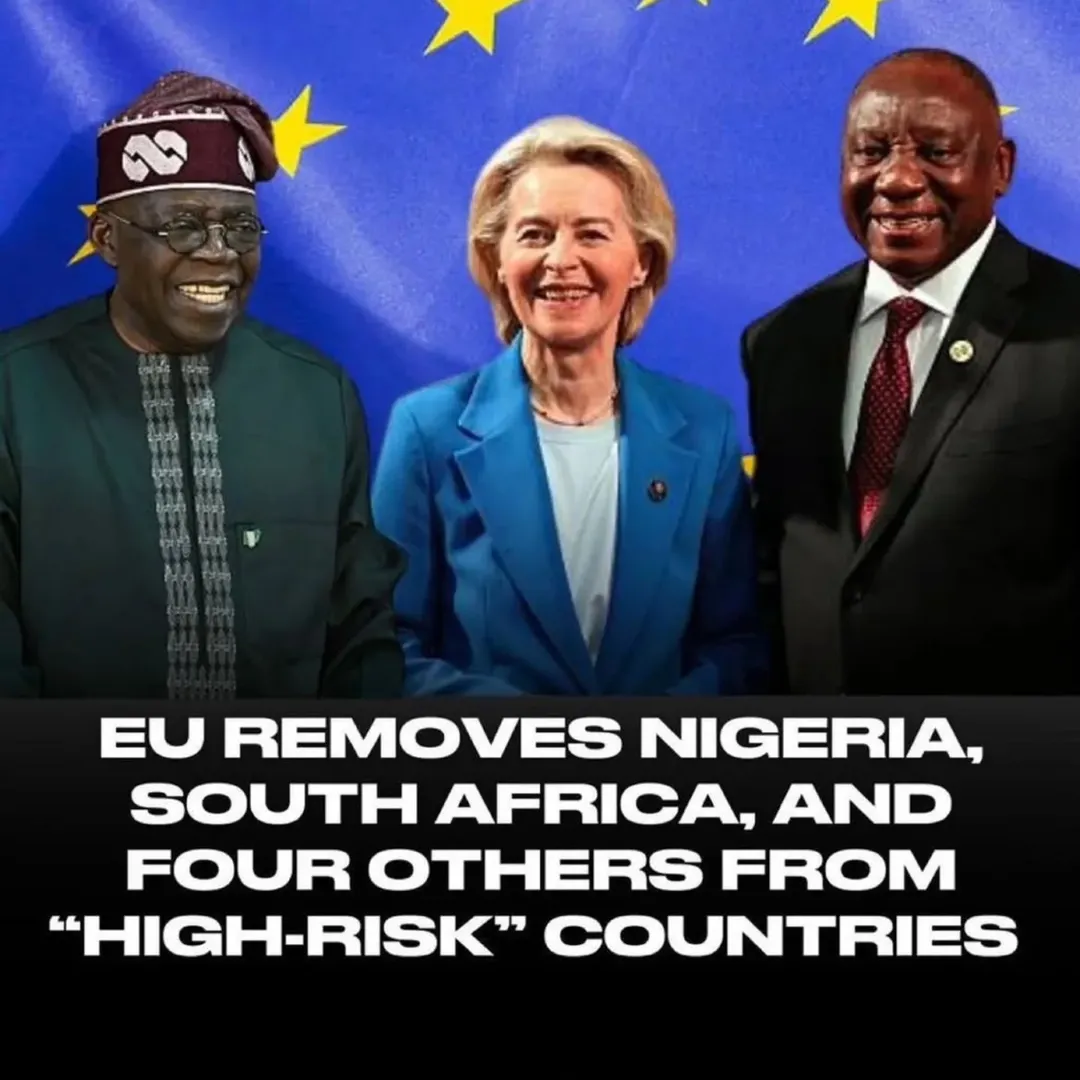
In a significant policy shift, the European Union (EU), has delisted Nigeria, South Africa, and four other countries from its official roster of “high-risk third-country jurisdictions” — a designation applied to nations considered to have strategic deficiencies in anti-money-laundering (AML), and counter-terrorist-financing (CFT) frameworks. The decision, published by the European Commission on 9 January 2026, takes effect on 29 January 2026 after review by the European Parliament and Council.
Which Countries Were Removed — and Why
The EU’s action follows a series of global regulatory developments, particularly decisions by the Financial Action Task Force (FATF), the global standard-setting body on AML/CFT.
In October 2025, Nigeria, South Africa, Mozambique, and Burkina Faso were removed from the FATF’s “grey list” — the list of jurisdictions under increased monitoring — after meeting conditions to strengthen their financial systems. Mali and Tanzania were also delisted, prompting the EU to align its own high-risk list with these global changes.
According to EU regulators, all six nations demonstrated progress in addressing technical deficiencies identified in their AML/CFT regimes, enabling the bloc to conclude that they no longer pose the same level of systemic risk.

What the “High-Risk” Label Means
Being placed on the EU’s high-risk list means that EU-based financial institutions — including banks, investment firms, auditors and lawyers — must apply “enhanced due diligence” on transactions involving clients, assets or counterparties in those jurisdictions.
This can include:
-
More intrusive checks on customer identity and sources of funds;
-
Higher documentation requirements for cross-border transfers;
-
Ongoing monitoring and senior-management sign-offs on covered transactions.
These measures are designed to protect the integrity of the EU’s financial system by preventing money laundering, terrorist financing and other illicit flows. However, they also increase compliance cost and friction for legitimate business, trade, and financial interactions.
Economic and Financial Impacts
The removal of the high-risk designation is widely seen as positive news for the affected countries:
1. Reduced Compliance Burdens
With the enhanced due-diligence requirements lifted, banks and businesses in Nigeria, South Africa and the other delisted countries will no longer automatically trigger heightened scrutiny on all EU-linked transactions. This can lower costs, speed up payments, and reduce operational barriers.
2. Encouraging Investment and Trade
Improved regulatory standing typically boosts confidence among international investors and trading partners. For countries like Nigeria and South Africa — key economic players in Africa — this could translate into increased cross-border capital flows and deeper financial integration with European markets.
3. Bank Relationships and Remittances
Removing the high-risk label may help ease correspondent banking restrictions that often accompany AML/CFT concerns. This can improve remittance services and broader banking relationships with European institutions, an important factor for many regional economies.
4. Political and Diplomatic Gains
For national governments, the delistings represent recognition of reform efforts. Nigeria’s removal from both the FATF greylist and the EU high-risk list has been hailed as a milestone by its finance officials.
South Africa similarly welcomed the EU’s decision as affirmation of its regulatory progress, although authorities caution that work continues to strengthen AML/CFT systems.
Policy Context and Legal Basis
The EU’s high-risk third-country list is maintained under Article 9 of Directive (EU) 2015/849, part of the bloc’s anti-money-laundering and counter-terrorist-financing framework. Under this law, the commission periodically assesses and updates the list based on FATF assessments, member-state feedback, and its own evaluations.
The EU also simultaneously added two new jurisdictions — Bolivia and the British Virgin Islands — to the high-risk list, demonstrating that the bloc’s vigilance against financial crime remains active even as progress is recognised in other regions.
What’s Next: Implementation and Outlook
The delisting becomes legally effective at the end of January, after the European Parliament and Council complete their scrutiny period.
Once active, the change means that EU financial institutions are no longer automatically required to treat the six delisted countries as high risk — though they retain the discretion to adjust internal risk assessments if their own compliance frameworks or risk models warrant it.
Analysts say the move could mark the start of deeper strategic engagement between the EU and these African economies — particularly around efforts to harmonise financial regulation and bolster cross-border trade. Yet, authorities in the affected countries acknowledge that continued vigilance against money laundering and terrorist financing remains necessary to sustain the regulatory gains that led to the delistings.
