

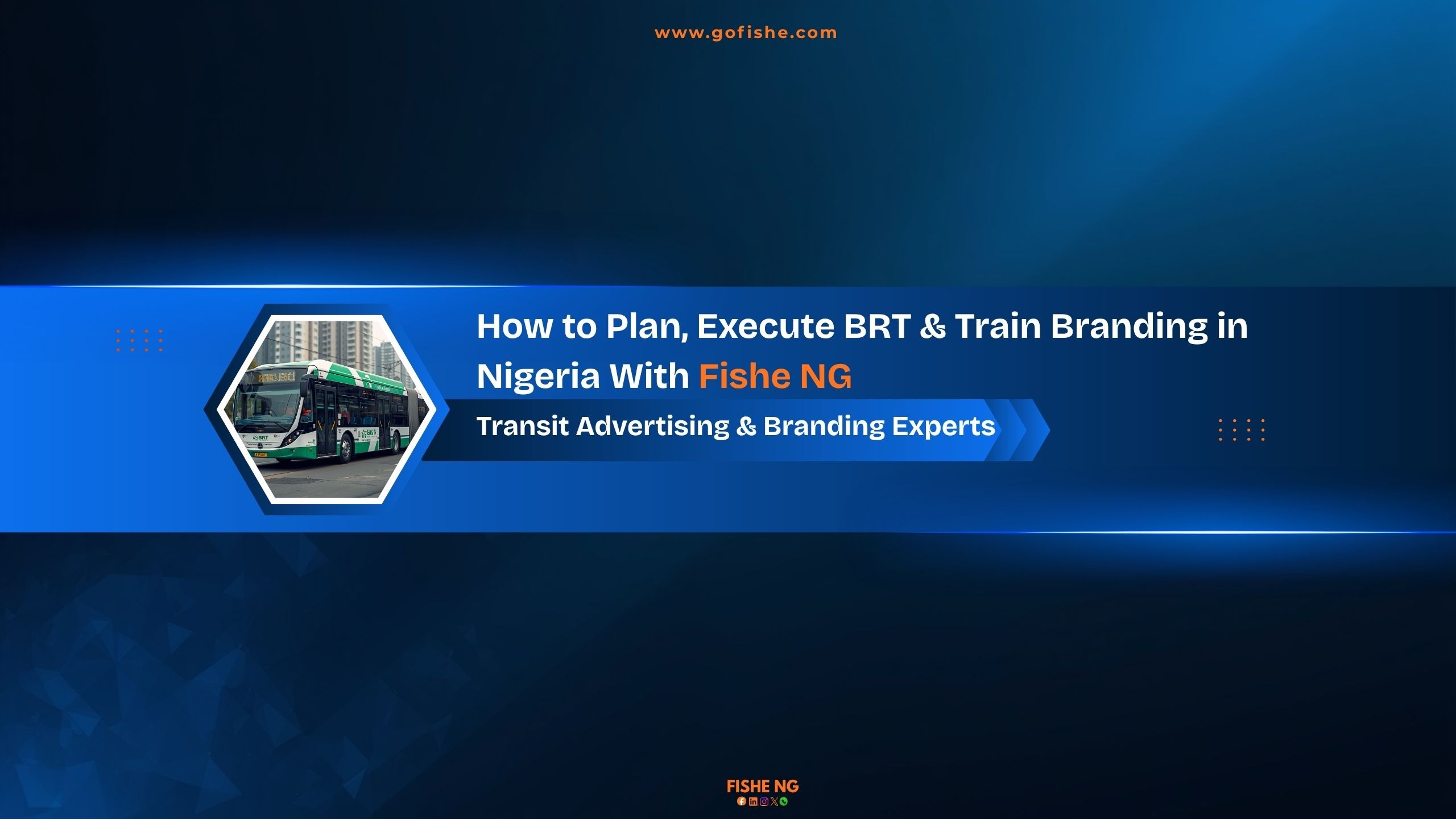
Urban mobility in Nigeria—especially in cities like Lagos and Abuja—is evolving rapidly. Bus Rapid Transit (BRT), systems and rail networks are not just transport solutions; they are moving billboards, civic identity markers, and behavioural influencers.
With agencies like Fishe NG positioned at the intersection of traditional and digital media, the opportunity is to transform transport branding into a high-impact communication ecosystem.
Start with Strategy, Not Design
Most transport branding in Nigeria fails because it starts with visuals instead of purpose.
A proper BRT/rail branding plan must define:
- Primary objective: Revenue (target audience) vs Identity (branding)
- Audience segments:
- Daily commuters
- Pedestrians
- Motorists
- Message hierarchy:
- Safety
- Public awareness
- Commercial advertising
Fishe NG’s strength in combining offline and digital strategy positions it well for this foundational stage.

Understand the Transport Environment
BRT and rail branding is not like billboard advertising.
Key environmental realities in Nigeria:
- Traffic congestion = longer dwell time (good for visibility)
- High pedestrian interaction
- Informal urban layouts
This means:
- Materials must be durable (laminated vinyl, anti-fade inks)
- Designs must be bold, high-contrast, and readable at speed
Brand Architecture for Transport Systems
A successful system uses layered branding:
Vehicle Branding (Buses & Trains)
- Full wraps
- Partial ads
- Interior branding
Station Branding
- Entry points
- Ticketing zones
- Platforms
Digital Extensions
- QR codes
- Mobile integration
- Social amplification
Fishe NG can differentiate itself here by building integrated offline–online journeys, not just physical designs.
Monetisation Strategy (The Real Game)
Transport branding is not just aesthetics—it’s a revenue engine.
Key revenue channels:
- Bus wraps (premium FMCG, telecoms)
- Station dominance ads
- Digital screens (future-ready)
- Naming rights (long-term)
Our ecosystem is still under-monetising this space compared to global standards.
Execution Framework
Phase 1: Audit & Mapping
- Route analysis
- Traffic density
- Visibility hotspots
Phase 2: Design System
- Templates for buses, trains, stations
- Compliance with regulations
Phase 3: Production
- Large-format printing
- Material testing (critical in Nigeria)
Phase 4: Deployment
- Phased rollout
- Minimal disruption to operations
Phase 5: Monitoring
- Brand visibility tracking
- Wear-and-tear audits
- Campaign performance
Common Mistakes in Nigeria
- Overcrowded designs (too much text)
- Poor material quality (fading in weeks)
- No maintenance plan
- Ignoring commuter psychology
- Lack of data tracking
Nigeria is not fully there yet—but early movers will dominate.
Conclusion
BRT and rail branding in Nigeria is still underdeveloped—but full of opportunity.
The winners in this space will be those who combine:
- Strategy
- Durable execution
- Monetisation intelligence
- Digital integration
